


What Makes a Bespoke Handmade English Kitchen Truly Unique?
Most kitchens are built to a standard. A bespoke handmade English kitchen is built to you.
It’s a distinction that sounds simple, but the difference in the finished result is profound. Where a standard kitchen is designed around modules, a bespoke English kitchen is designed around your home, your lifestyle, and the way you actually live. Where a factory-produced kitchen ages uniformly, a handmade kitchen develops character. And where a fitted kitchen from a catalogue will eventually look like every other fitted kitchen from that catalogue, a truly bespoke English kitchen looks like nothing else, because there’s nothing else quite like it.
In this guide, we explore what genuinely separates a bespoke handmade English kitchen from the alternatives, and why, for the right home and the right homeowner, nothing else quite compares.
What Is a Bespoke Handmade English Kitchen?
The word “bespoke” is used freely in the kitchen industry, sometimes to mean little more than choosing a door colour from a limited palette. In its truest sense, a bespoke kitchen is one that has been designed from scratch around the specific dimensions, architecture, and requirements of a single home, for a single client.
A bespoke, handmade English kitchen takes this further. It combines made-to-measure design with traditional cabinetmaking techniques, solid wood construction, hand-painted finishes, and the kind of joinery detail that simply cannot be replicated by machine or mass production. Every component is crafted with the finished room in mind, not adapted from a standard unit to approximate a fit.
The English kitchen as a style sits at the intersection of traditional British craftsmanship and contemporary living. It draws on centuries of furniture-making heritage — the clean geometry of Shaker design, the warmth of natural timber, the depth of hand-applied paint — and interprets those principles for modern kitchens that are still expected to work hard every single day.
The result is a kitchen that feels rooted. Considered. Unmistakably hand-made.
Explore the Karl Benz English Kitchens collection
The Hallmarks of English Kitchen Design
Shaker-Style Cabinetry – The Foundation of the English Kitchen
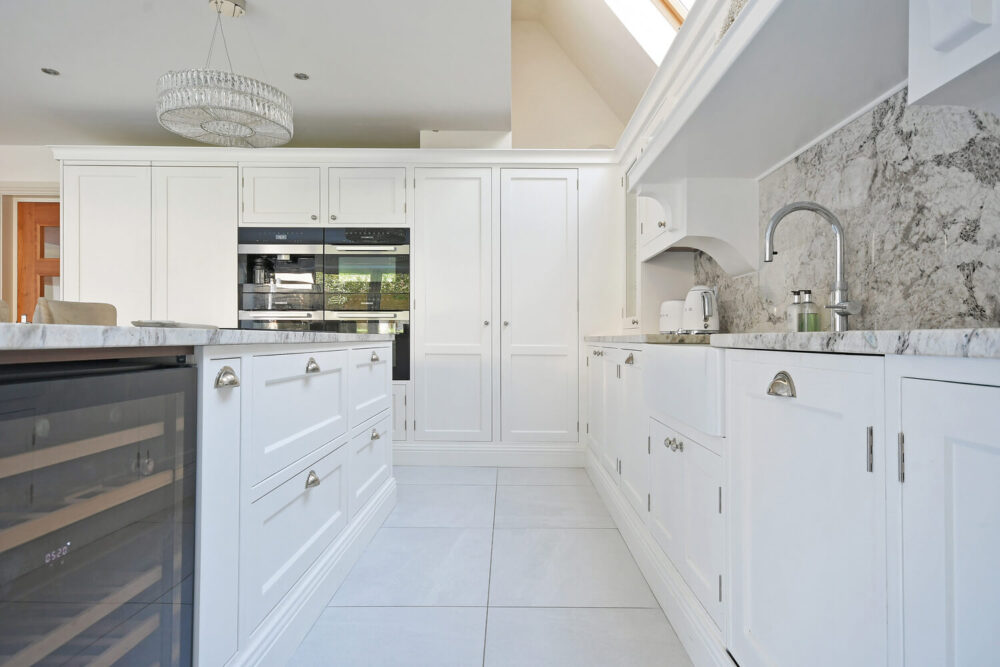
No design style has proven more enduring in the British kitchen than the Shaker. Originating with the American Shaker communities of the 18th century, the style was defined by a commitment to honest, functional design: nothing superfluous, every detail purposeful. Frame and panel construction, clean recessed doors, precise joinery, a Shaker cabinet is as beautiful from the back as it is from the front.
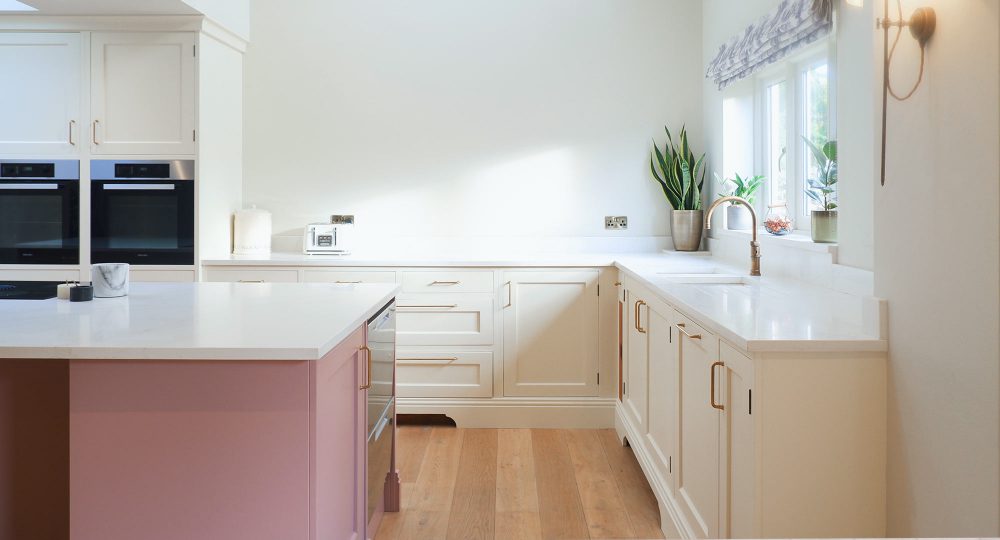
In the context of a modern English kitchen, Shaker cabinetry provides a foundation of quiet elegance that works with almost any interior. It’s traditional enough to feel at home in a Victorian terrace or a Derbyshire farmhouse, and clean enough to sit alongside contemporary appliances and stone worktops without looking out of place.
What distinguishes a handmade Shaker door from a mass-produced equivalent is the construction. A genuine frame-and-panel door is built to move; the solid wood panel is free to expand and contract with seasonal changes in humidity, which is why well-made English kitchen cabinetry doesn’t crack or warp the way cheaper alternatives eventually do. The frame is assembled with mortise and tenon joints, glued and pinned with precision. It’s cabinetmaking in the traditional sense, and it shows.
Hand-Painted Finishes – Colour That Can’t Be Replicated
Walk into a kitchen showroom, and you’ll see hundreds of painted finishes. Most are applied in a factory by machine: sprayed, dried, wrapped, or laminated. The result is uniform and consistent, which is precisely its limitation.
A hand-painted finish is different in every way. Applied by skilled decorators using specialist paints formulated for timber, each coat is brushed and sanded by hand, building up a depth and texture that machine application simply cannot achieve. The finish has a subtle variation across its surface, not a flaw, but a quality. It catches light differently depending on the angle, and it integrates with the grain and character of the wood beneath in a way that factory finishes do not.
Hand-painted kitchens can be matched to virtually any colour, not just the standard ranges offered by manufacturers, but bespoke mixes developed specifically for your home. At Karl Benz, we work with clients to find the exact tone that suits their space, their lighting, and their taste, whether that’s a classic off-white, a deep heritage green, or something entirely their own.
And crucially, a hand-painted finish can be touched up and refreshed over time. A chipped factory finish is damaged permanently. A hand-painted kitchen can be repaired invisibly, and repainted completely if the owner’s taste changes, a quality that fundamentally changes the long-term economics of the investment.
Solid Wood Construction – Built to Last Generations
The cabinetry of a bespoke English kitchen is built from solid hardwood — oak, ash, walnut, or painted hardwood, depending on the design brief. This matters more than it might seem.
The majority of kitchen cabinets sold in the UK, including many marketed as “luxury”, are built from MDF carcasses with foil-wrapped or sprayed doors. MDF is a stable and practical material, and there’s nothing wrong with it in the right context — but it is not the same as solid timber, and it does not age the same way. Over time, MDF is susceptible to moisture ingress at joints and edges; it cannot be planed or refinished, and a damaged component generally has to be replaced entirely.
A solid wood kitchen behaves differently. It is repairable. Individual components can be restored, re-painted, re-planed, and returned to their original condition. A well-maintained hardwood kitchen doesn’t just survive for decades; it improves. The timber acquires patina. The hand-painted finish deepens. The kitchen becomes, over time, a piece of the house rather than a fitting installed in it.
Joinery techniques in a handmade English kitchen reflect this commitment to longevity. Dovetail joints in drawer boxes. Mortise and tenon frames. Solid wood back panels. These are not decorative flourishes; they are structural choices made by craftspeople who build kitchens to last thirty years, not ten.
Why “Made-to-Measure” Is More Than Just a Size
A standard kitchen is designed around modules: 300mm, 400mm, 500mm, 600mm wide units, arranged to fill a room as efficiently as possible. Filler panels bridge the gaps between units and walls. Corner units compromise on storage to accommodate the geometry of the space. The kitchen fits the room; it doesn’t belong to it.
A bespoke made-to-measure kitchen works the other way around. The design begins with the room, its exact dimensions, its architectural features, its quirks and opportunities — and every element is designed to respond to that specific space.
This matters enormously in the kinds of homes where English kitchens tend to live. Victorian and Edwardian houses in Sheffield’s southern suburbs Dore, Millhouses, Brincliffe, Totley, rarely have perfectly square rooms or standard ceiling heights. Derbyshire farmhouses and Hope Valley barn conversions have sloped ceilings, exposed beams, stone walls, and chimney breasts that a standard kitchen simply cannot accommodate without awkward compromise.
A bespoke kitchen designed for these spaces can work with the architecture rather than against it. Units can be built to exact non-standard widths. Ceiling-height cabinetry can follow a rake. A chimney breast can become a feature rather than an obstacle, with flanking larder units designed to frame it. The kitchen, in the end, looks as though it grew from the room — because in a meaningful sense, it did.
Beyond pure dimensions, made-to-measure design unlocks storage solutions that standard modules cannot offer. Full-height larder units designed around your specific provisions. Pull-out pantry systems built to your exact requirements. Integrated spice drawers, hidden appliance garages, and cutlery inserts milled to fit your specific cutlery. In a bespoke English kitchen, storage is not an afterthought, it is a core element of the design, considered from the very first conversation.
Learn more about our design process at Karl Benz
The Role of the Kitchen Designer in a Bespoke Project
A bespoke handmade English kitchen begins long before any timber is cut. It begins with the design process, and the quality of that process has more influence on the finished kitchen than almost any other factor.
At Karl Benz, the design journey starts with a conversation. Not a sales conversation, but a genuine exploration of how you use your kitchen, how you want it to feel, what you cook, how you entertain, what you love about your current kitchen and what frustrates you about it. From that conversation, a picture of the right kitchen begins to emerge, and it’s almost always different from what the client imagined at the outset.
The site survey that follows is not a formality. Our designers visit the property to take precise measurements, assess the architecture, understand the light, and identify the constraints and opportunities that only become apparent when you’re standing in the space. This is what separates a genuinely bespoke design from one that’s simply been scaled from a standard template.
From there, the design develops through a collaborative process: mood boards, material samples, and detailed drawings that allow the client to understand exactly what the finished kitchen will look like before anything is ordered. The second showroom visit, where the design is presented in full, is a moment most clients describe as the point where the project becomes real.
Working with award-winning designers matters in a bespoke project in a way it simply doesn’t when selecting from a catalogue. The skills involved, spatial thinking, material knowledge, an understanding of proportion, light, and how people move through a space, directly determine the quality of the finished result.
Book your free, no-obligation design consultation
English Kitchen vs. German Kitchen vs. Italian Kitchen – How Do They Compare?
Karl Benz offers three distinct kitchen collections, and understanding the difference between them is the most useful starting point for any new project.
The English kitchen is defined by warmth, craftsmanship, and tactile materiality. It is the most traditional of the three in its design language, rooted in handmade cabinetry, natural materials, and a philosophy of longevity over novelty. It suits homes with character and history, and homeowners who want their kitchen to feel like a natural extension of the house rather than a showpiece installation. It is not, however, limited to traditional aesthetics: a well-designed English kitchen can be entirely contemporary while remaining grounded in the same craft principles.
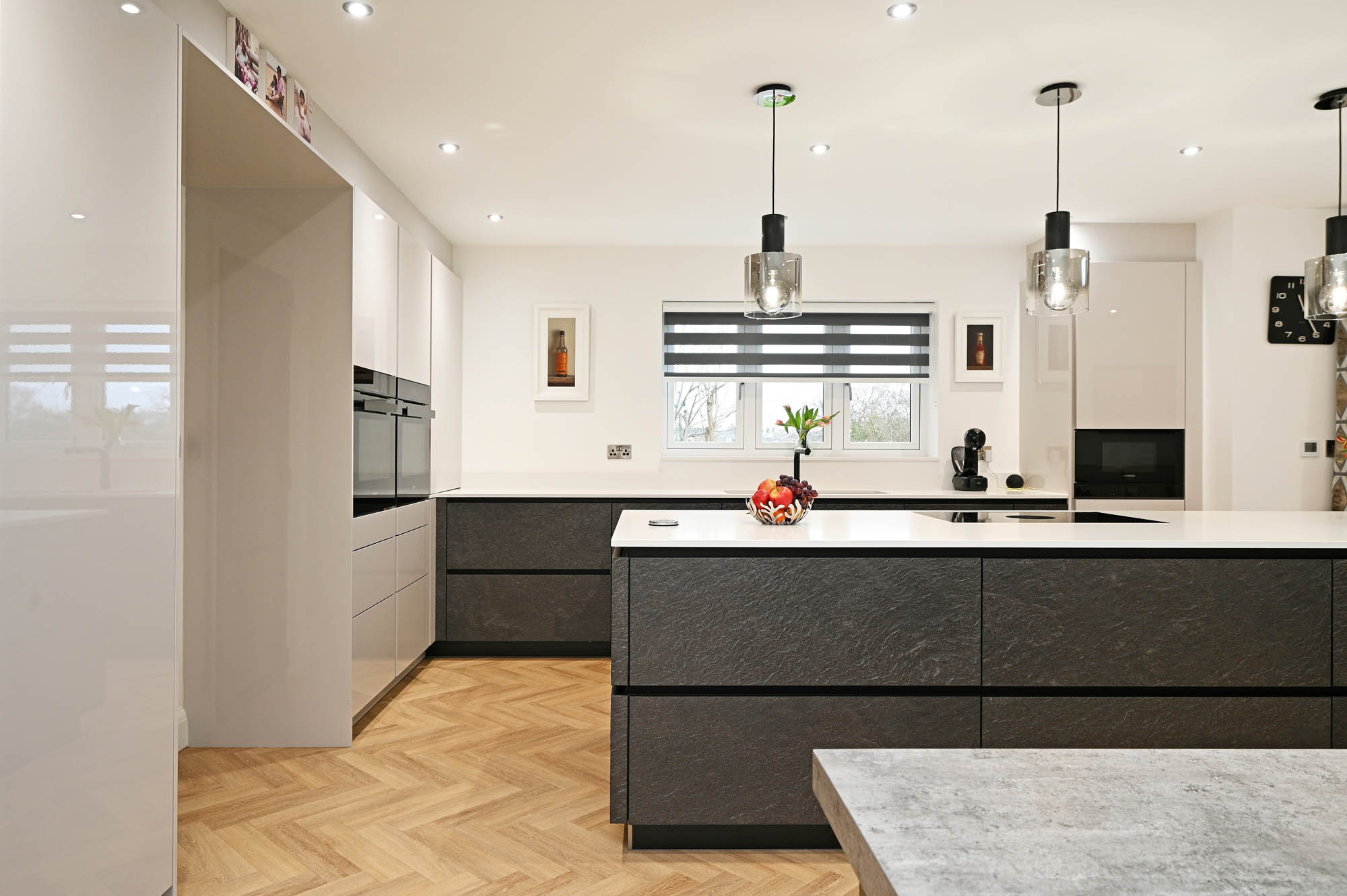
The German kitchen is the opposite in many respects: precision-engineered, minimalist, and defined by clean lines and handleless cabinetry. The manufacturing process is carbon-neutral and designed to exact specifications with zero waste. German kitchens suit homeowners who favour a sleek, uncluttered aesthetic and want their kitchen to function with the kind of mechanical precision associated with the finest European engineering. They are also an outstanding long-term investment, built to last well over 20 years and maintain their appearance throughout.
The Italian kitchen brings a design-led sensibility that sits between the two: more expressive than the German, more contemporary than the English. Through the Doimo Cucine partnership, Karl Benz offers Italian kitchens that combine sophisticated material choices, bold lacquers, statement veneers, sculptural forms, with the underlying quality of craftsmanship that defines everything we produce.
None of these is inherently superior to the others. The right choice depends on your home, your taste, and the way you live.
Explore German Kitchens | Explore Italian Kitchens
Materials That Define the English Kitchen
Worktops – Natural Stone, Hardwood, and Beyond
In an English kitchen, the worktop is not simply a functional surface, it is a material statement that ties the whole design together. The most traditional choice is solid hardwood: thick-cut oak or walnut butcher block that brings warmth and texture to the room and develops a rich patina with use and oiling. It is a material that rewards care, and in the right kitchen, feels completely irreplaceable.
For those who want the beauty of natural stone with greater durability, marble and granite remain the definitive luxury choices. Marble’s veining brings a unique character to every slab , no two are identical, and its cool, smooth surface has a visual weight that elevates any kitchen it appears in. Granite is harder, more resistant to staining, and arguably more practical in a busy family kitchen while losing nothing in terms of visual quality.
Quartz engineered stone offers a middle ground: the appearance of natural stone with greater consistency and lower maintenance requirements. For a contemporary English kitchen where practicality is as important as aesthetics, it is an increasingly popular choice.
Hardware – The Details That Make the Difference
If the cabinetry is the architecture of an English kitchen, the hardware is its jewellery. Handle and knob choices have an outsized influence on the character of the finished room, and in a handmade English kitchen, they deserve the same level of consideration as any other element.
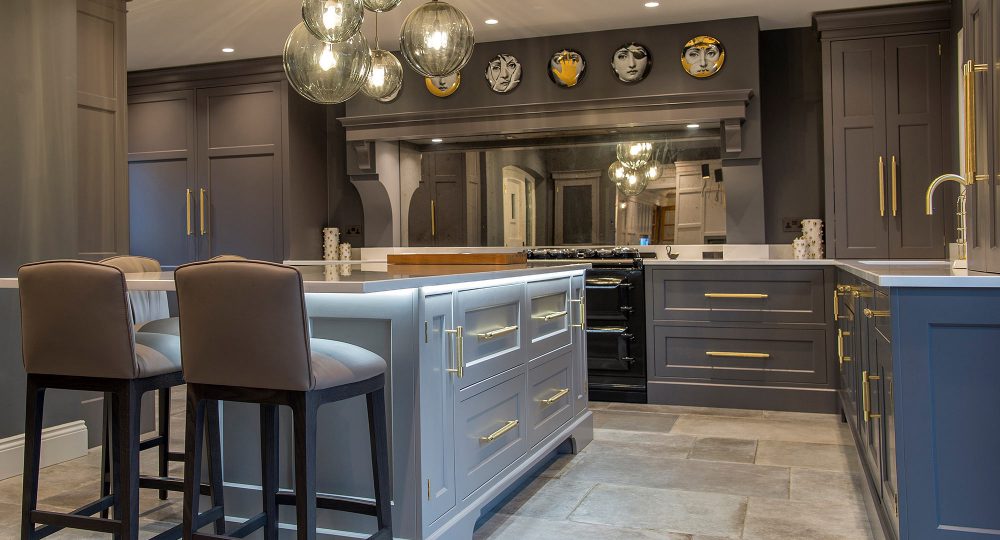
Brass is the defining hardware finish for the English kitchen: warm, rich, and endlessly versatile. Unlacquered brass develops a living patina over time, gradually acquiring the warmth of an antique while remaining firmly contemporary in form. Pewter offers a quieter, more muted alternative with the same heritage associations. Ceramic knobs, white, off-white, or hand-painted, bring a softer, more cottage feel that suits English kitchens in rural or period settings.
The scale and profile of handles matter as much as the finish. A substantial cup pull on a deep drawer. A slender bar handle on an eye-level cabinet. These are decisions that a skilled designer will navigate with care, because getting them right is the difference between a kitchen that looks considered and one that merely looks expensive.
Flooring and Splashbacks
An English kitchen belongs to its setting, and the flooring and splashback choices are where that connection is most strongly expressed.
Traditional flagstone, whether reclaimed Yorkshire stone, slate, or limestone, is the natural companion to an English kitchen in a period or rural property. It is cool, durable, and speaks directly to the architectural heritage of the building. Wide-plank hardwood flooring offers warmth and continuity, particularly in open-plan spaces where the kitchen flows into a dining or living area.
For splashbacks, handmade ceramic tiles are the defining choice in the English kitchen: irregular in surface, rich in colour, and full of the character that machine-made tiles lack. Metro tiles in off-white or sage, encaustic patterned tiles as a feature panel, or bespoke hand-painted ceramic inserts, the options are as individual as the kitchen itself.
Is a Bespoke English Kitchen Worth the Investment?
It is the question most clients ask, usually in the early stages of the conversation. And it deserves an honest answer.
A bespoke handmade English kitchen costs more than a standard kitchen. It costs more than a semi-bespoke kitchen. Understanding why and what that investment delivers is the key to answering the question.
The most straightforward case is longevity. A well-made, solid wood kitchen, properly maintained, will last thirty years or more, and remain beautiful throughout. A standard kitchen has a useful life of ten to fifteen years before the finish deteriorates, the hardware wears, and the carcasses begin to fail. Over a thirty-year period, the bespoke kitchen is not simply the more beautiful choice, it is often the more economical one.
Repairability reinforces this. When a door of a handmade English kitchen is damaged, it can be stripped, repainted, and restored to its original condition. When a drawer box breaks, it can be rebuilt. When the owner’s taste changes, the kitchen can be repainted in an entirely different colour, transformed without replacement. A factory-finished kitchen offers none of these options.
The impact on property value is also meaningful, particularly in the areas Karl Benz serves. A kitchen is one of the most scrutinised rooms in any house sale, and a genuinely beautiful bespoke kitchen, well-designed for the space and built to last, adds value that a standard kitchen simply does not. In high-value postcodes in Sheffield’s south-west and across the Peak District, buyers actively respond to quality.
And then there is the value that resists quantification entirely: a kitchen designed for how you live, in the home you’ve made, that you enjoy every single day. That is not a luxury in the pejorative sense. It is exactly what a kitchen should be.
For detailed pricing information, read: How Much Does a Luxury Kitchen Cost?
English Kitchens in Sheffield and the Peak District
There is something particular about the relationship between the English kitchen and the homes of Sheffield’s south-west and the surrounding Peak District. It is not a coincidence that this style resonates so strongly here, it is a response to the architecture.
Sheffield’s Victorian and Edwardian housing stock, the substantial stone-built semis of Dore, the period terraces of Millhouses and Brincliffe, the large detached houses of Totley and Whirlow, provides exactly the setting where an English kitchen feels most at home. High ceilings, original cornicing, bay windows and flagstone floors create a context in which warmth, craft, and natural materials are not just aesthetically appropriate but architecturally necessary. A sleek, handleless kitchen can work beautifully in these settings, but for many homeowners, an English kitchen feels like the honest choice.
Out into Derbyshire, the case becomes even stronger. Stone farmhouses in the Hope Valley, barn conversions around Curbar and Eyam, Georgian rectories in the Derwent Valley, these are buildings with two hundred years of material character, and they call for kitchens that speak the same language. Handmade cabinetry. Natural stone. Aged brass. Wide-plank oak. A kitchen that doesn’t compete with its setting but deepens it.
Karl Benz has designed and installed English kitchens across this landscape for over a decade. We understand both the architecture and the people who choose to live in it. Every kitchen we design in this region begins with a question about the house itself, because the best English kitchen is always, in some sense, a response to the building it lives in.
View our case studies across Sheffield and Derbyshire
Bespoke Handmade English – FAQs
What is the difference between a bespoke kitchen and a custom kitchen?
The terms are often used interchangeably, but there is a meaningful distinction. A custom kitchen typically means selecting from a manufacturer’s range of modules, finishes, and sizes, there is some flexibility, but within a predefined system. A bespoke kitchen is designed from scratch around a specific space and client, with no predetermined constraints on dimensions, materials, or design. Every element is made to order.
How long does a handmade English kitchen take to make and install?
The timeline varies depending on the complexity of the project, but as a general guide, a bespoke handmade English kitchen typically takes between 10 and 20 weeks from confirmed order to installation. The design and consultation phase, which precedes the order, adds further time. We always discuss realistic timelines at the outset, so there are no surprises.
Can an English kitchen work in a modern or open-plan home?
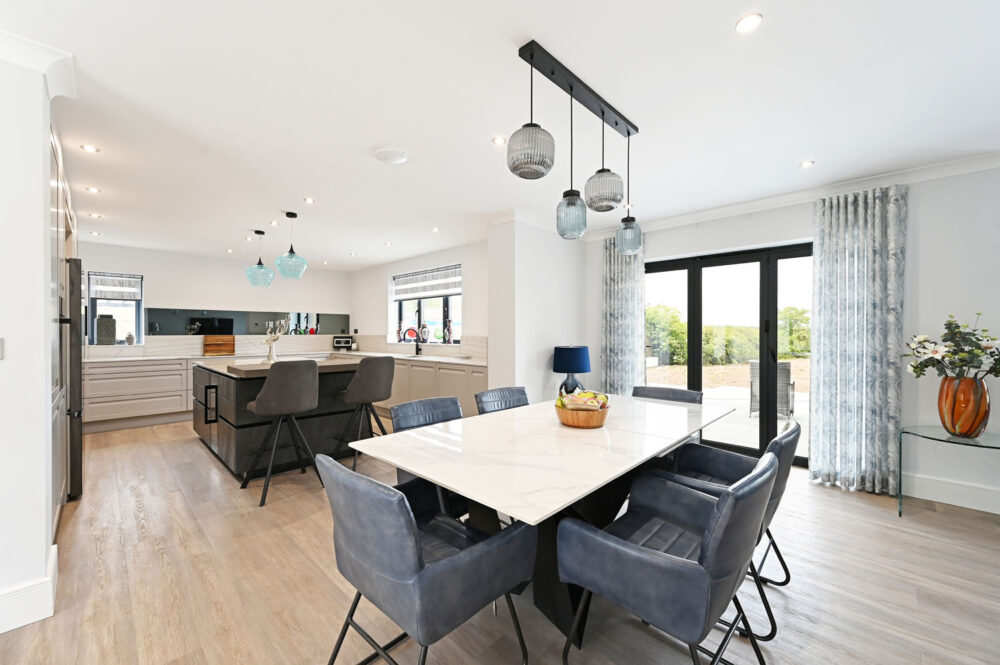
Absolutely. The English kitchen is not limited to period properties. The design principles, quality materials, careful proportion, handmade craftsmanship, translate extremely well into contemporary open-plan spaces, particularly where the aim is to create warmth and texture in a large room. A Shaker-door English kitchen in a modern extension, paired with contemporary appliances and a concrete or stone worktop, is a combination that works beautifully.
What wood is best for a handmade English kitchen?
Oak is the most commonly specified timber for English kitchen cabinetry, durable, widely available, and beautiful in both its natural and painted forms. Ash offers a lighter, more contemporary alternative with a striking grain. Walnut brings depth and richness and is increasingly popular for statement islands and open shelving. The right choice depends on the overall design and the desired character of the finished kitchen.
How do I care for a hand-painted kitchen?
Hand-painted kitchens are more straightforward to maintain than many clients expect. Day-to-day cleaning requires nothing more than a soft, damp cloth, avoid abrasive cleaners or scouring pads, which can damage the finish. Over time, high-traffic areas such as door edges and around handles may show light wear, which can be touched up by a decorator. A full repaint, which completely transforms the kitchen, is also possible if tastes change.
